
What is Brazilian Jiu Jitsu?
Brazilian Jiu Jitsu (BJJ) promotes the idea that a smaller, weaker person can successfully defend against a bigger, stronger assailant. By using proper technique, leverage, and taking the fight to the ground, followed by applying joint locks and chokeholds, a smaller individual can defeat their larger opponent. Sparring/rolling plays a major role in training, and performance is key, especially in competition.
Once the opponent is on the ground, several techniques and counter-techniques are used to manipulate them into a suitable position for the final application of a submission technique, i.e. a choke or joint crank.
Achieving a dominant position on the ground is one of the hallmarks of Brazilian Jiu Jitsu. This includes effectively using the guard position to defend oneself while in the bottom position, utilising both submissions and sweeps. Sweeps from the bottom can lead to obtaining the dominant position or an opportunity to pass the guard, leading to domination from the top.
Why learn Brazilian Jiu Jitsu?
Brazilian Jiu Jitsu training can be used for sport grappling tournaments (Gi and No-Gi), Mixed Martial Arts (MMA), competitions and self defence.
When watching two experienced students, this system of manoeuvring and manipulation can be likened to kinetic chess. A submission hold is the equivalent of a checkmate, reflecting a disadvantage which would be extremely difficult to overcome in a fight.
Brazilian Jiu Jitsu is suitable for ages 10 and older.
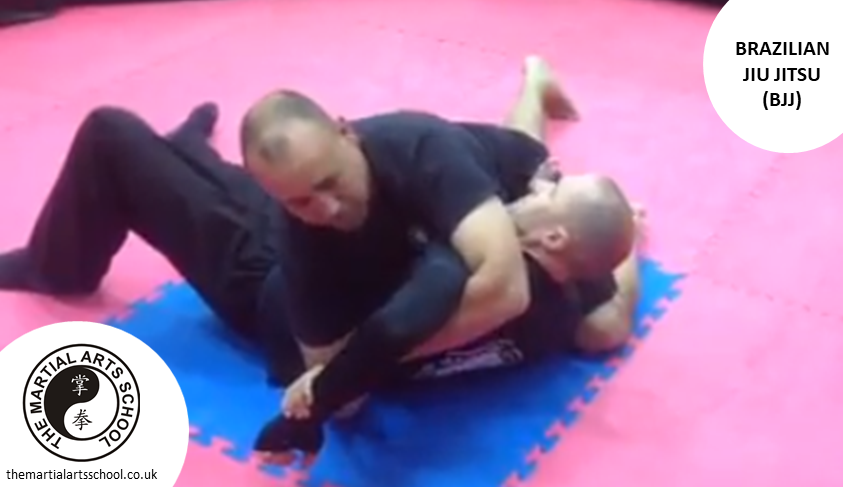
Brazilian Jiu Jitsu No-Gi Grappling training technique